

-
Orange will train 6 million people in digital skills by 2030 through its Orange Digital Centers.
-
The network includes 53 centers across Africa and the Middle East, with 1.4 million beneficiaries in 2025.
-
Orange positions trust as a competitive advantage under its “Trust the Future” 2026–2030 strategy.
The digital sector has become a strategic arena where economic ambitions, social expectations, and sovereignty issues converge. Telecom operators now face a dual challenge as they connect users and prove their ability to support Africa’s long-term transformation.
Against this backdrop, Orange has placed trust at the center of its growth model. The company introduced its “Trust the Future” strategic plan for 2026–2030 during a press event held on April 7 and 8 in Morocco. The group assigned a central role to Orange Middle East and Africa in executing this strategy.
Orange defined trust through network quality, cybersecurity, innovation, and corporate responsibility. However, the company also builds trust in Africa through direct engagement with youth, entrepreneurs, and local ecosystems. In this context, the Orange Digital Centers (ODC) represent one of the most tangible pillars of the strategy.
Orange stated that trust has evolved from a communication tool into a competitive advantage in an increasingly complex digital environment. The company aims to build long-term relationships with African youth by providing technical support, improving employability, and strengthening credibility in the job market.
Orange committed to training 6 million people in digital skills by 2030, primarily through its Orange Digital Centers. The company delivers these programs free of charge to expand access and inclusion.
An Integrated Model
The Orange Digital Center ecosystem has expanded across Africa and the Middle East and now includes 53 centers operating in 16 African countries and Jordan. The network partners with 167 universities.
In 2025, the centers reached 1.4 million beneficiaries, including 42% women. The program also supported 450 startups, with 24 receiving funding from Orange Ventures. As a result, the ODC network has moved beyond experimentation and now operates as a structured regional ecosystem.
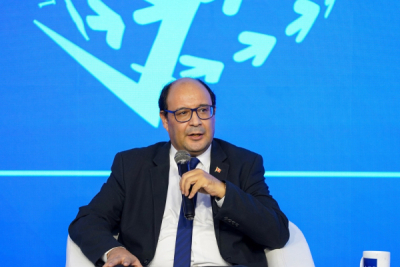
According to Alia Sahaly, the model derives its strength from integration. The Orange Digital Centers combine multiple components, including coding schools, FabLabs for prototyping, Orange Fab for startup acceleration, and Orange Ventures for financing. This end-to-end value chain links training to investment and reinforces the company’s trust-driven approach.
Employability and Reskilling
Employability remains a core pillar of the ODC model. The centers have delivered 42,000 certifications in partnership with global platforms such as Amazon Web Services, Coursera, and Google.
The program has accumulated more than 277,000 training hours and introduced 13 specialized tracks. It has also issued 500 Google professional certificates focused on web development, cybersecurity, artificial intelligence, UX/UI design, data, and cloud computing.
The “Master Repair” initiative illustrates the reskilling strategy. The program trains participants in mobile device repair, solar panel installation, and fiber network maintenance.
Rising Demand for Training
Entrepreneurship forms the second pillar of the ODC model. Orange has supported innovators for 16 years through initiatives such as the Orange Summer Challenge and the Orange Social Venture Prize in Africa and the Middle East. The company also accelerates startups commercially through Orange Fab.
In addition, Orange highlighted the role of Orange Ventures, a €50 million ($58 million) investment fund, in financing high-potential startups. Through these initiatives, Orange positions itself not only as a connectivity provider but also as a builder of Africa’s digital economy.
Performance metrics support this positioning. Orange reported that 69% of surveyed participants said their skills improved significantly, while 71% said the program contributed meaningfully to their personal and professional development. Three-quarters of respondents reported regular use of acquired skills.
Moreover, Orange stated that demand for training can reach up to 40 times available capacity in some countries, reflecting strong market appetite.
Ultimately, the Orange Digital Center embodies the broader objectives of the “Trust the Future” strategy. The initiative demonstrates that trust depends not only on network reliability or data protection but also on education, inclusion, local innovation, and entrepreneurial support.
In Africa and the Middle East, which Orange identifies as a key growth engine, the ODC network functions as a dual-purpose asset. It delivers social impact while strengthening credibility, talent pipelines, and long-term sustainable growth.