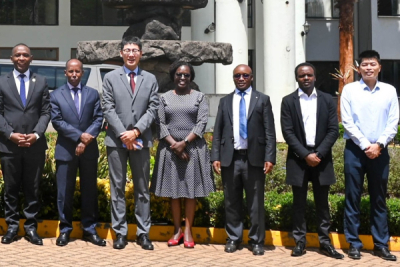


- Kenya’s School of Government is discussing a partnership with Huawei’s local unit to support public-sector digital transformation.
- The talks include a potential memorandum of understanding covering cloud, artificial intelligence, and cybersecurity skills.
- Kenya plans to digitize all public services and deploy 1,450 community digital centers under its 2022–2032 Digital Master Plan.
The Kenya School of Government (KSG), a public institution responsible for strengthening citizens’ skills, is exploring a partnership with the local subsidiary of Chinese technology company Huawei. The potential collaboration aims to support the country’s ongoing digital transformation.
KSG said the discussions focused on leveraging emerging digital technologies to strengthen leadership development, institutional efficiency, and innovation within the public administration. The talks also examined the development of a memorandum of understanding to anchor long-term cooperation on digital capacity building for senior officials, knowledge transfer, and national digital transformation priorities.
“Our objective is to build a public service that is not only digitally literate, but also capable of effectively applying cloud, artificial intelligence, and cybersecurity tools to improve service delivery, strengthen institutional performance, and protect citizens’ data,” said Nura Mohamed, Director General of KSG, as reported by TechTrend.
The initiative aligns with Kenya’s broader digital transformation agenda, which positions information and communication technologies as a pillar of socio-economic development.
Through its Digital Master Plan 2022–2032, Kenya aims to deploy 1,450 community digital centers and digitize all public services. In this context, the Organisation for Economic Co-operation and Development said investment in civil-service skills has become essential, as digital technologies can transform public administration by enabling more accessible and efficient services.
“Achieving digital government, where technology is applied to the design of processes, policies, and services that meet users’ needs, requires the adoption of new ways of working and new skills within public administrations,” the OECD said in its February 2024 report Developing skills for digital government: A review of good practices across OECD governments. “Governments must promote the skills, attitudes, and knowledge that allow civil servants to operate in a digital environment by integrating digital technologies to create public value.”
UNESCO said civil servants should not become technical experts. The organization said public officials should instead understand emerging technology trends and acquire a basic understanding of the societal implications of technology to lead digital transformation and governance initiatives.
UNESCO added that digital planning and design, data use and governance, and digital management and execution represent three essential skill areas that civil servants must master, depending on their country’s digital transformation needs.
This article was initially published in French by Isaac K. Kassouwi
Adapted in English by Ange Jason Quenum