

- Ivory Coast partners with University of Montpellier to train space engineers and develop its first satellite.
- The initiative supports the rollout of the national space agency and existing satellite projects.
- African countries plan more than 100 additional satellite launches by 2030, reflecting rapid sector growth.
Ivory Coast seeks to leverage the expertise of University of Montpellier in France to train its first cohort of space specialists. The collaboration will also cover the development of the country’s first national satellite.
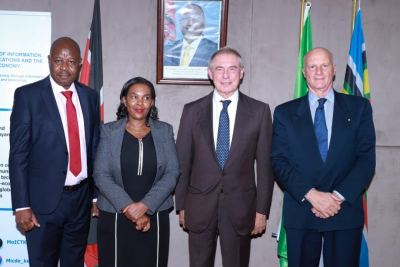
Authorities discussed this cooperation on Wednesday, April 15, during a meeting between Adama Diawara, Minister of Higher Education and Scientific Research, and a delegation from the Space Center of the University of Montpellier led by its director Laurent Dusseau.
This meeting marked an initial step in launching the activities of the Ivorian Space Agency (ASCI), which authorities established to structure the sector.
According to the Ivorian government, Dusseau emphasized that the University of Montpellier provides infrastructure capable of training technicians and engineers by combining theoretical knowledge with practical skills.
He stated: “We deliver this training through a specialized master’s program designed for engineers who already hold degrees in various fields and who complete an अत्य intensive one-year course to acquire space expertise that enables them to access highly specialized roles such as IT engineer or systems engineer.”
This initiative forms part of broader efforts to develop the space sector in Ivory Coast. In May 2023, the country announced a partnership with Universal Konstructors Associated (UKA) to build Yam-Sat CI 01, the first national satellite, with a launch initially scheduled for August 2024.
Earlier, authorities announced plans in 2021 to establish a national space agency, and they formalized the creation of the agency by decree in June 2025. The agency oversees capacity building and infrastructure development in the space sector.
The Council of Ministers outlined the agency’s scope in its June 4, 2025 report and confirmed that its activities cover key pillars of the space sector. “Its scope of activity covers essential pillars of space applications, namely Earth observation, space weather, astronomy, space exploration, as well as satellite navigation and communication,” the report stated.
The government added that these capabilities will address economic development challenges, strengthen national security, and support environmental protection.
Ivory Coast’s efforts align with a broader continental trend. A report by the Africa Center for Strategic Studies published in September 2025 indicated that African states allocate approximately $500 million annually to space programs.
The study reported that more than 21 African countries have established space programs, while 18 have launched at least one satellite. African nations have launched a cumulative total of 65 satellites and plan to deploy more than 120 additional satellites by 2030.
This article was initially published in French by Isaac K. Kassouwi
Adapted in English by Ange J.A de Berry Quenum