

-
Orange plans to invest more than €5 billion in Africa and the Middle East between 2026 and 2028.
-
The group targets over 40 million new 4G and 5G users by 2028.
-
Africa and the Middle East generated €8.4 billion in revenue in 2025, up 12.2%, leading group growth.
As its historical European markets reach maturity, Orange shifts its center of gravity toward Africa and the Middle East. The French telecommunications group plans to invest more than €5 billion between 2026 and 2028, double its fibre customer base and build more than 15,000 new telecom sites in rural areas under its new strategic plan, “Trust the Future.”
A Strategy Built on Trust and Innovation
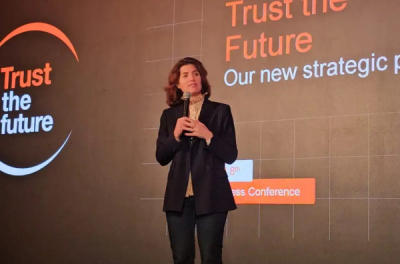
Orange presented the plan to the international press on April 8, 2026, in Casablanca, Morocco. The strategy focuses on trust and rests on three ambitions: customer proximity, growth through innovation and excellence at scale.
Chief Executive Officer Christel Heydemann said the group aims to reassure customers on service availability, quality, usefulness and reliability, particularly in high-speed connectivity, which underpins digital transformation.
“In a world where digital complexity and risks increase, expectations for service quality, security and simplicity evolve rapidly, while AI transforms every sector. In this context, trust becomes a decisive criterion. ‘Trust the Future’ materializes Orange’s advantage in trust through reliable networks, built-in cybersecurity, responsible data and AI practices, and seamless user experiences. Trust forms the foundation on which the Group will build its future,” the company said.
Orange bases its growth ambitions in Africa on the continent’s ongoing transformation. Mobile technology already acts as a key driver of economic and social development.
The mobile ecosystem accounted for 7.7% of GDP, or $220 billion, in 2024, and it could reach $270 billion by 2030, according to the GSM Association (GSMA).
This momentum reflects several structural trends, including a young and fast-growing population, rising digital usage, increasing adoption of data-driven services, expansion of 4G and 5G networks, continued growth in mobile financial services and stronger demand for accessible and locally relevant solutions.
Under this strategy, Orange targets more than 40 million additional 4G and 5G users by 2028. In 2025, the operator reported 179 million customers across its 17 African markets and Jordan, an increase of 14 million subscribers in one year. The group also counted more than 90 million 4G users, while it offered 5G services in seven markets: Egypt, Morocco, Tunisia, Jordan, Senegal, Botswana and Madagascar. Its fibre and fixed broadband base reached 4.8 million customers.
Expanding Beyond Connectivity
Orange’s expansion in Africa extends beyond network infrastructure. The group aims to position the continent as a growth driver for higher value-added services, including mobile finance, super apps, cloud computing, cybersecurity, artificial intelligence and enterprise services.
The company targets double-digit growth in its business-to-business segment, with a focus on IT services. It also plans to integrate AI and language models across both network operations and commercial offerings.
The strategy aims not only to connect users but also to capture a larger share of the digital value generated across the continent. This importance already reflects in the group’s financial results. In 2025, Africa and the Middle East contributed the most to Orange’s growth, generating €8.4 billion in revenue, up 12.2%. EBITDAaL also increased by 13.9%.
However, Orange faces potential headwinds in Africa. The World Bank Group’s latest semiannual report on Sub-Saharan Africa, published on April 8, 2026, forecasts regional growth at 4.1% in 2026, unchanged from 2025, while highlighting rising downside risks.
Higher prices for fuel, food and fertilizers, combined with tighter financial conditions, could drive inflation higher, disrupt economic activity and disproportionately affect vulnerable households, which allocate a larger share of income to food and energy.
This article was initially published in French by Muriel EDJO
Adapted in English by Ange J.A de Berry Quenum