

-
The government launched a subsidized sale of 664,000 digital devices, including 400,000 reserved for women and girls.
-
Authorities financed the scheme under the $24 million DECIM fund to expand affordable access to digital equipment.
-
Only 18.7% of the population used the Internet in 2024, highlighting a wide digital gap.
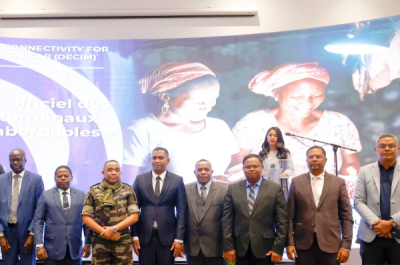
Officials officially launched on February 21 a national program to sell 664,000 subsidized digital devices. The program allocates 400,000 units to women and girls. The initiative seeks to expand access to digital terminals, reduce the digital divide, and strengthen sustainable digital inclusion, particularly for women and youth.
The government has structured the program around a network of nine contracted official distributors to ensure process transparency, equipment accessibility and gradual nationwide coverage, including rural areas. Authorities have integrated the initiative into the “Affordable Digital Equipment” subcomponent of the $24 million Digital and Energy Connectivity for Inclusion in Madagascar (DECIM) fund.
Authorities first unveiled the program in April 2025 as part of a broader strategy to support socio-economic development through digital transformation. The Digitization Strategic Plan (PSN) 2023–2028 frames this strategy and sets a roadmap to position Madagascar as a leading player in Africa’s digital economy. The plan emphasizes telecommunications development, e-government and digital inclusion. Authorities expect the digital sector to contribute 6% to GDP by 2028, compared with 1.5% in 2019.
However, Madagascar continues to face a pronounced digital divide. According to the International Telecommunication Union (ITU), only 18.7% of the population used the Internet in 2024. The World Bank estimates the population at 32.9 million. The GSMA notes that smartphone affordability remains a major barrier to Internet adoption, even in areas already covered by networks, despite devices now retailing for under $100.
At the same time, the scale of the initiative remains modest relative to the population still excluded from digital services. Authorities have not announced subsequent phases or a precise timeline for expansion.
Access to smartphones alone does not guarantee adoption and effective use of digital services. Network coverage also constrains inclusion. ITU data show that 2G and 3G networks covered 88.5% and 69.2% of the population respectively at end-2023. Meanwhile, 4G coverage reached 34.6% in 2024, and 5G covered only 6.12%. High Internet costs, limited digital skills, security concerns, connectivity quality and the perceived relevance of digital services for some communities further limit uptake.
Digital infrastructure can unlock productivity gains, but hardware subsidies represent only one piece of a broader structural equation that includes connectivity, affordability and trust in digital ecosystems.
Isaac K. Kassouwi