

-
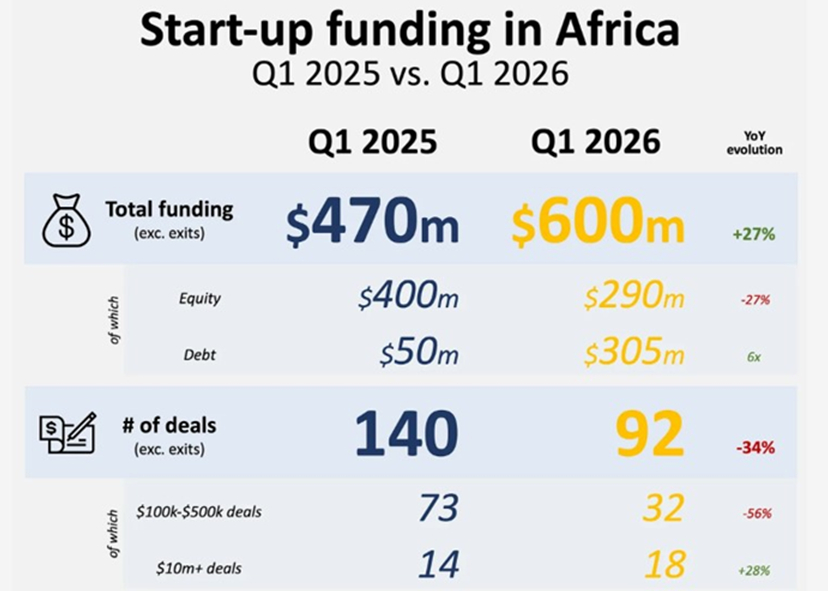
Debt financing accounted for $305 million of the $600 million raised by African startups in the first quarter of 2026.
-
Startups increasingly turned to non-dilutive financing as higher interest rates and investor caution slowed equity funding.
-
Early-stage companies faced mounting pressure as the number of small fundraising rounds sharply declined.
Debt financing became the leading source of funding for African startups for the first time during the first quarter of 2026, marking a structural shift in the continent’s technology investment landscape.
Debt represented $305 million of the $600 million raised by African startups during the quarter, compared with just $50 million during the same period in 2025, according to data from Africa: The Big Deal.
The shift extended a trend that has accelerated over recent years. According to Partech’s 2025 annual report, published in January 2026, debt financing in Africa’s startup ecosystem increased from $1.01 billion at the end of 2024 to $1.64 billion at the end of 2025, representing year-on-year growth of 63%.
The number of debt transactions followed the same trajectory. Transactions increased by 40% to a record 108 deals across the continent in 2025.
Debt accounted for 41% of total capital invested in African startups in 2025, compared with 31% in 2024 and 17% in 2019.
“We observed that debt financing represented the most significant structural change of 2025. Although debt financing remained marginal a few years ago, it has become a central pillar of African technology funding,” Partech said in its report.
The investment firm said the increase reflected a lasting transformation rather than a cyclical recovery. A growing number of African startups now generate sufficient cash flow, operational scale and governance standards to access structured and non-dilutive financing instruments.
In April 2026, Togolese mobility startup Gozem secured $24.5 million in debt financing from the International Finance Corporation (IFC) to expand its vehicle fleet.
At the same time, Kenyan agritech startup Victory Farms obtained $15 million in financing through AgDevCo.
“The figures appear positive at first glance, but the sharp decline in equity financing and the scarcity of small funding rounds reflect a tougher environment for seed-stage startups,” said Max Cuvellier Giacomelli, co-founder of Africa: The Big Deal.
Geographic distribution data also revealed major disparities across African markets.
Kenya led the continent in debt financing during 2025 with $498 million raised through debt instruments, representing 48% of all capital deployed in the country.
Egypt followed with $246 million in debt financing, up 73% year on year, while Nigeria secured $160 million, up 132%. Senegal attracted $139 million, while South Africa raised $72 million, down 45%.
However, the rapid growth of debt financing coincided with a sharp contraction in overall deal activity.
The total number of startup funding transactions fell by 34% between the first quarter of 2025 and the first quarter of 2026, declining from 140 to 92 deals.
Small funding rounds ranging between $100,000 and $500,000 dropped from 73 transactions to 32 over the same period.
As a result, many early-stage startups that lack the scale or revenue growth required to access debt financing increasingly found themselves excluded from parts of the funding market.
This article was initially published in French by Adoni Conrad Quenum
Adapted in English by Ange J.A de Berry Quenum