
Medical robotics is reshaping healthcare in Africa, creating new opportunities to improve care quality and streamline costs. But the continent faces significant hurdles, from workforce training to financing, if these technologies are to deliver tangible benefits for patients.
Medical robotics, covering robot-assisted surgery, diagnostics and hospital logistics, is emerging as a lever for healthcare modernization in parts of Africa.
According to Data Bridge Market Research, the medical robotics market in the Middle East and Africa is forecast to grow at a compound annual rate of 13.5% between 2022 and 2029. The market is projected to expand from $451.26 million in 2021 to $1.14 billion by 2029.
Despite this growth, adoption across Africa remains limited compared with other regions and is largely confined to higher-income countries or those with advanced hospital infrastructure.
Flagship initiatives across the continent
South Africa is among the most advanced markets. Several public hospitals have performed more than 600 robot-assisted procedures, mainly in urology and gynecology. Hospitals report shorter recovery times and fewer post-operative complications.
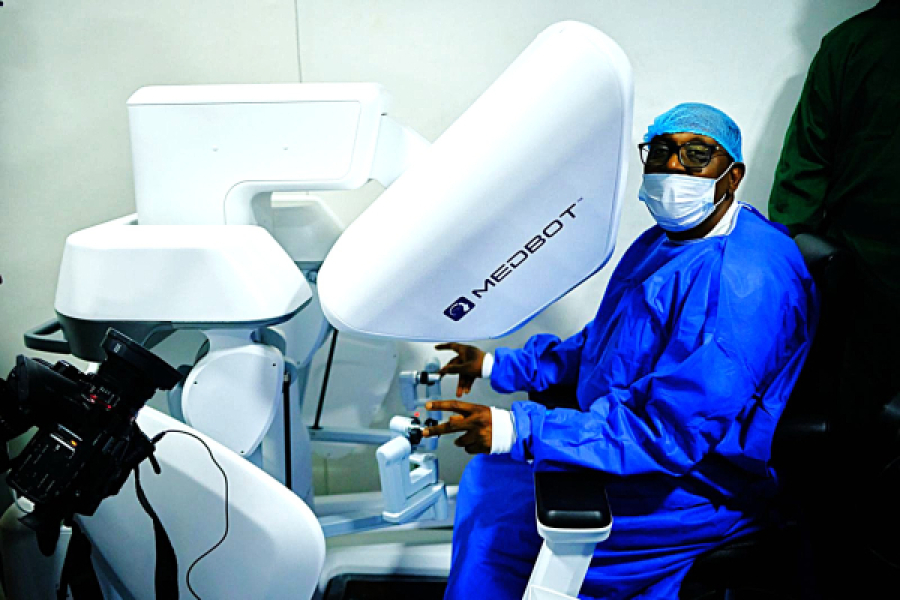
In Nigeria, authorities recently approved a robotic surgery platform, enabling such procedures in a public hospital for the first time.
In Luanda, Angola, medical teams have conducted telesurgery trials using robotic systems. These tests suggest robotic surgery could be deployed even in settings with limited network capacity.
Morocco has also positioned itself as a regional pioneer. A radical prostatectomy was performed remotely between Casablanca and Shanghai, demonstrating the feasibility of long-distance telesurgery. Additional procedures between Moroccan cities point to growing domestic expertise and institutional interest in robotic surgery.
Beyond surgery, robotics is being deployed in Kenya and other countries for hospital logistics and assistance tasks. This improves operational efficiency and allows nursing staff to focus on clinical care.
Barriers to wider adoption
Cost remains the primary constraint. Robotic systems often cost several million dollars, limiting access for public hospitals. A platform such as the da Vinci 5 typically ranges between $1.5 million and $2.5 million, excluding maintenance and consumables.
Training is another major hurdle. Robot-assisted procedures require specialized surgical and technical skills, as well as ongoing certification.
Institutions such as Ircad Africa in Rwanda are addressing this gap by training African surgeons in minimally invasive and robotic techniques. At the same time, the rise of startups and innovation hubs focused on artificial intelligence, robotics and e-health could support longer-term ecosystem development.
Medical robotics also presents regulatory and ethical challenges, including liability in case of system failure, data protection standards and the role of automation in patient care.
Growth trajectory despite constraints
Globally, the surgical robotics market is expected to exceed $22.89 billion by 2030, according to Spherical Insights. Emerging economies investing in healthcare digitization could capture part of this expansion.
For African countries, scaling medical robotics will depend on coordinated public policy, targeted investment, workforce training and international partnerships. If these conditions are met, robotics could become a practical tool for strengthening healthcare systems and improving the quality of care.
Samira Njoya