



Kajou raises €1mln to develop digital training content in Africa

The low mobile internet penetration rate in Africa (only 28% in 2020 according to GSMA) is a huge obstacle to online learning. To tackle this issue and make learning content more accessible, the startup Kajou came up with an offline solution. The company is now in full expansion.
Kajou closed a €1 million round of financing last January 10, with the impact investment funds Phitrust, Colam Impact, and Hippolyte Capital. Business Angels, mostly from the Ashoka network, also took part in the round. The beneficiary plans to use the money to intensify its activity in Senegal and accelerate the development of its digital training content offer in West and Central Africa, particularly in Senegal, Côte d'Ivoire, Benin, Togo, and Cameroon.
The digital training content offered by Kajou is available on micro SD cards that can be inserted into a smartphone. The information is then accessed via the Kajou application. Users can browse up to 32 gigabytes (GB) of selected content in local languages. Multiple sectors, including health, the environment, agriculture, and entrepreneurship are covered. The app also allows users to share content with their friends, without using data.
Jérémy Lachal (pictured), the founder of Kajou, sees the digital solution as "a great tool to bring knowledge directly to your phone. It allows you to consult thousands of contents without using your Internet data. We are knowledge activists. Because where there is knowledge, there is hope.”
Kajou has been in operation for 18 months and already has more than 20,000 users. The startup is a response to the need for access to knowledge in Africa, where the mobile Internet penetration rate is still only 28%, according to "The Mobile Economy: Sub-Saharan Africa 2021" report by the Global System Operators' Association (GSMA).
Kajou wants to reach more than 3 million people in West Africa with its digital library. It sees this investment as a way to allow its users to get information, educate themselves, and develop their professional activity.
Muriel Edjo
Gabon seeks to digitize primary education
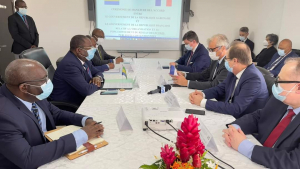
The government of Gabon announced a partnership with the United Nations Children's Fund (UNICEF) to introduce digitalization in primary education. A meeting was held for this purpose between the Gabonese Minister of National Education, Professor Patrick Mougiama-Daouda, and the resident representative of Unicef in Gabon, Dr. Noël Marie Zagre. This initiative aims to make distance learning more dynamic through new technologies.
"The program will spread over five years. We plan to establish a mechanism that will help both students and teachers to get used to the digital tools. A first phase will see us implement the project in 3 schools per region," said Dr. Noël Marie Zagre.
The UNICEF Resident Representative also revealed that the program will later cover secondary and higher education. "It will take into account all aspects including staff training, infrastructure, and content to ensure that primary education can benefit from the digital," he said.
Gabon gradually started its digital migration process about a decade ago. With the advent of Covid-19, the country wants to accelerate its process.
Brice Gotoa
Benin: Govt accelerates its digital education project

The government of Benin has adopted a new five-year multi-sectoral plan for digital migration. For the education component, the government has defined a technical framework to accelerate the digitalization of the sector. A workshop was organized for this purpose on January 27 by the Minister of Digitalization, Aurelie Adam Soulé Zoumarou (pictured).
It was attended by Salimane Karimou, Minister of Nursery and Primary Education; Eléonore Yayi Ladekan, Minister of Higher Education and Scientific Research; and Kouaro Yves Chabi, Minister of Secondary and Technical Education and Vocational Training.
According to Aurelie Zoumarou, the meeting enables participants to set “the fundamentals of the information system to be put in place, as well as the governance and the roadmap of the e-Education project.” She stressed that “per the vision of the government, the e-Education project must optimize learning and foster a better quality of the transmission of knowledge using digital tools.” The e-Education project is a sub-component of the Government Action Program (PAG) 2021-2026, in its fifth strategic axis: "promotion of quality education and technical and vocational training." Accelerating the project will help the government address the challenges faced by the sector during the coronavirus pandemic.
Once implemented, e-Education will contribute to improving the governance and management of education systems, introducing new teaching and learning practices, improving the monitoring and development of learners, making certificates and diplomas more reliable, strengthening teachers' capacities and skills, and improving research.
Adoni Conrad Quenum