
- Morocco plans to generate 100 billion dirhams ($11 billion) in additional GDP from artificial intelligence by 2030.
- The government expects AI adoption to create 50,000 jobs and train 200,000 graduates in AI-related skills.
- Morocco will launch the Jazari Root AI network, including a 50-MW sovereign data center, to anchor its national ecosystem.
Morocco has placed artificial intelligence at the center of its economic transformation strategy. By 2030, the kingdom aims to generate 100 billion dirhams in additional GDP, equivalent to about $11 billion, through structured AI deployment. Official projections also link this strategy to the creation of 50,000 jobs and the training of 200,000 graduates in AI-related skills.
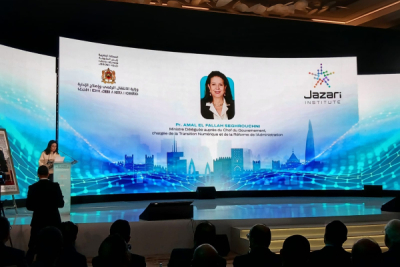
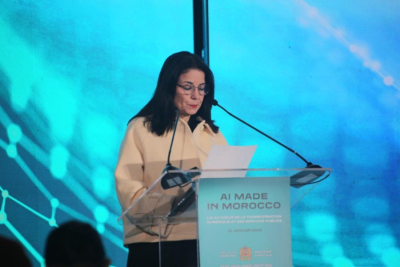
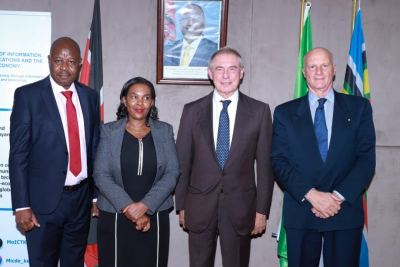
Amal El Fallah Seghrouchni, Minister Delegate for Digital Transition and Administrative Reform, unveiled these targets on Monday, January 12, in Rabat during a digital-focused conference. She stated that Morocco’s current GDP stands at around $170 billion and described artificial intelligence as a major growth lever, provided authorities integrate it within a structured, sovereign, and impact-driven framework.
These announcements form part of Morocco’s forthcoming national artificial intelligence strategy, whose roadmap authorities plan to release shortly. The strategy rests on several pillars, including skills development, the build-out of sovereign digital infrastructure, and the expansion of cloud and data-processing services capable of supporting advanced AI use cases nationwide.
To operationalize this ambition and structure the national ecosystem, Morocco also announced the launch of the Jazari Root network, which will serve as a central hub for the country’s artificial intelligence ecosystem. The project will include a 20-hectare campus and a 50-MW sovereign data center. Jazari Root aims to bring together researchers, startups, large companies, and public institutions around applied projects ranging from e-government and smart cities to agriculture, healthcare, and logistics.
By structuring investments and its ecosystem at an early stage, Morocco seeks to position itself as a credible artificial intelligence player at regional and African levels. The kingdom aims to capture part of the value that AI could generate in the global economy, which PwC estimates at nearly $15.7 trillion by 2030.
This article was initially published in French by Samira Njoya
Adapted in English by Ange Jason Quenum